

Hip Flexors:
Understanding Their Role and Why They Often Cause Issues

When we think about our hips, we usually picture the muscles at the back, like the gluteus maximus and gluteus medius. These powerhouses, along with the hamstrings, are responsible for hip extension and rank among the strongest muscles in the body. But the hip is a complex joint, and while the rear muscles are essential, we often overlook the equally important hip flexors at the front.
What Are Hip Flexors?
Hip flexors include key muscles like the iliopsoas, which is actually a group of three muscles that come together to attach at the lesser trochanter of the femur. Another major player is the rectus femoris, which uniquely functions as both a hip flexor and a knee extensor. This muscle connects the tibia (lower leg) to the pelvis at the ASIS, allowing it to flex the hip and extend the knee.
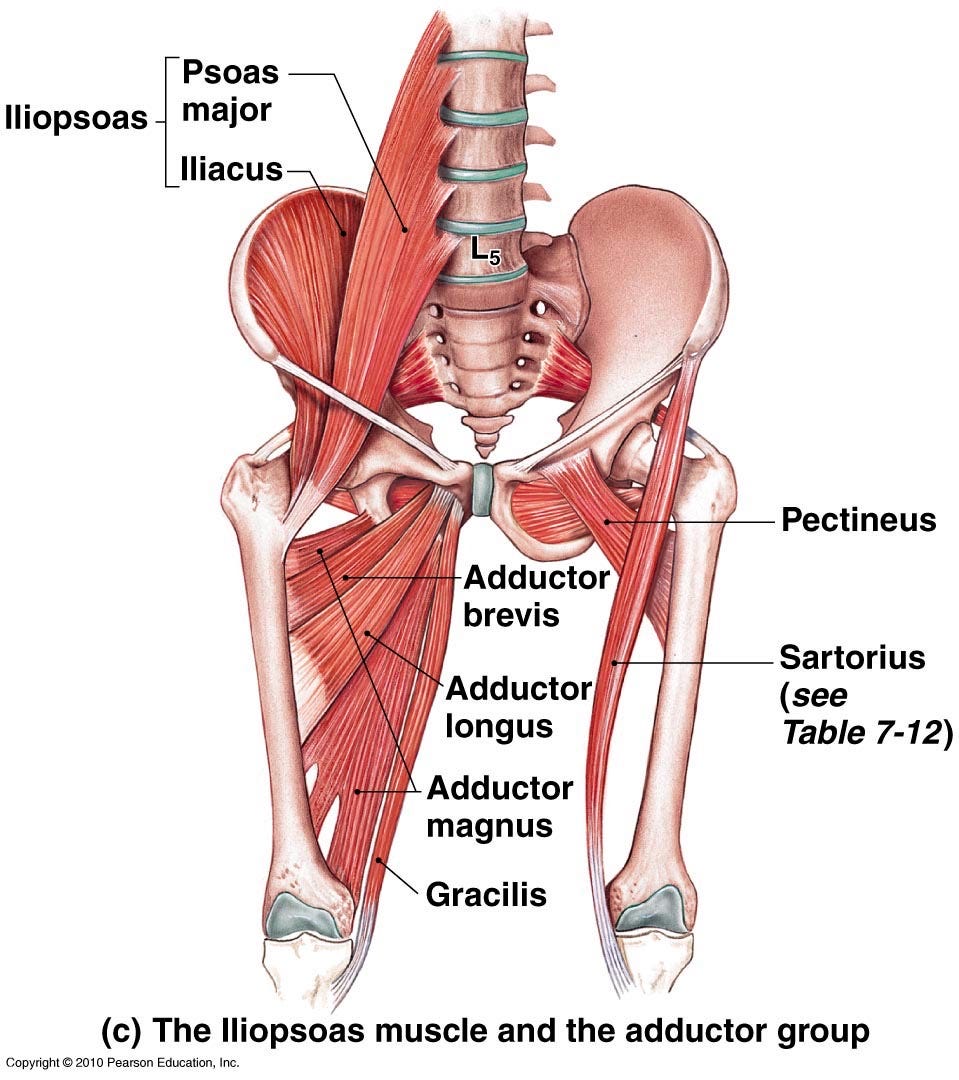
Why Should You Care About Hip Flexors?
These muscles are crucial for several reasons. They allow for hip flexion (moving your femur toward your torso), help stabilize your lumbar spine, and keep the front of your hip joint steady. Hip flexors are also essential for powerful movements like running and sprinting, where they contribute to that all-important hip drive.
Common Issues with Hip Flexors
Hip flexors are often labeled as stiff or restricted, largely because of the time we spend sitting, driving, or even sleeping with our hips in a flexed position. When these muscles are stuck in a shortened state, it can lead to a reduced stride length when walking or running. This restriction can also impact your lower back, leading to an exaggerated arch (lordosis) or causing you to walk in a hunched posture.
While our spines are designed to flex and extend, problems like pain and discomfort can emerge from holding the same posture for too long. It’s not that any specific posture is inherently bad—it’s the prolonged nature of certain positions that can cause issues.
Limited hip flexor length doesn’t just affect walking and running; it can also make movements like squatting and kneeling more difficult.
What Can You Do About It?
Stretching your hip flexors is crucial for maintaining mobility, musculoskeletal health, and proper hip function. Despite common fears, strengthening your hip flexors won’t make them stiffer. In fact, strengthening can enhance lower body function and reduce that familiar feeling of stiffness.
For practical tips and exercises to stretch and strengthen your hip flexors, check out my social media channels on Instagram, YouTube, and TikTok. I’ve got plenty of home-friendly routines that can help you take care of these often-overlooked muscles.
References:
Khan, A., & Malik, A. N. (2023). Association between hip flexor tightness and lumbar instability in adults. Journal of the Pakistan Medical Association, 73(11), 2239-2241. https://doi.org/10.47391/JPMA.8221
Lifshitz, L., Bar Sela, S., Gal, N., Martin, R., & Fleitman Klar, M. (2020). Iliopsoas the hidden muscle: Anatomy, diagnosis, and treatment. Current Sports Medicine Reports, 19(6), 235-243. https://doi.org/10.1249/JSR.0000000000000723
Hirase, T., Mallett, J., Barter, L. E., Dong, D., McCulloch, P. C., & Harris, J. D. (2020). Is the iliopsoas a femoral head stabilizer? A systematic review. Arthroscopy, Sports Medicine, and Rehabilitation, 2(6), e847-e853. https://doi.org/10.1016/j.asmr.2020.06.006
Seyedhoseinpoor, T., Taghipour, M., Dadgoo, M., Ebrahimi Takamjani, I., Sanjari, M. A., Kazemnejad, A., Elliott, J. M., & Hides, J. (2022). Relationship between the morphology and composition of the lumbar paraspinal and psoas muscles and lumbar intervertebral motion in chronic low-back pain: An exploratory study. Clinical Anatomy, 35(6), 762-772. https://doi.org/10.1002/ca.23893
Thorborg, K., Bandholm, T., Zebis, M., Andersen, L. L., Jensen, J., & Hölmich, P. (2016). Large strengthening effect of a hip-flexor training programme: A randomized controlled trial. Knee Surgery, Sports Traumatology, Arthroscopy, 24(7), 2346-2352. https://doi.org/10.1007/s00167-015-3583-y
Akalan, N. E., Kuchimov, S., Apti, A., Temelli, Y., & Nene, A. (2016). Weakening iliopsoas muscle in healthy adults may induce stiff knee pattern. Acta Orthopaedica et Traumatologica Turcica, 50(6), 642-648. https://doi.org/10.1016/j.aott.2016.03.007